
TALK TO A SOLAR ADVISOR NOW
No pressure. Real Answers.
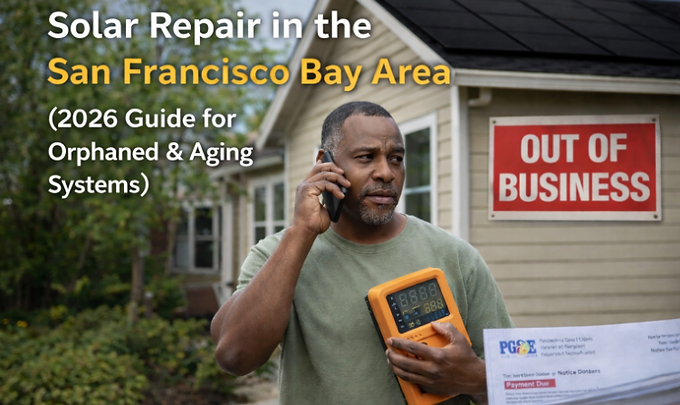
Solar Repair in the San Francisco Bay Area (2026 Guide for Orphaned & Aging Systems)
What to Do When Your Solar Company Is Gone
Quick Summary (2026 Bay Area Reality)
If your solar installer is no longer operating, you still have options. In the San Francisco Bay Area, many systems installed between 2016–2021 are now aging, unsupported, or underperforming. Solar repair, retrofit, or structural transition can restore performance and reduce PG&E exposure but replacement is rarely the first step.
In 2026, more Bay Area homeowners are facing an unexpected situation:
Their solar company has disappeared.
Disconnected phone numbers.
Monitoring offline.
Warranty confusion.
No one returning service calls.
With PG&E electricity rates exceeding $0.48/kWh in many cases, leaving a system unresolved is not neutral — it increases exposure.
The real question isn’t:
“Who can replace my panels?”
It’s:
“Does my current system still protect me from PG&E volatility?”
Why So Many Solar Companies Closed in the Bay Area
The California solar landscape changed dramatically:
NEM 3.0 reduced export compensation
Residential tax credits expired
Insurance and labor costs increased
Smaller installers struggled to maintain capital stability
As a result, many Bay Area homeowners now own what the industry calls an “orphan solar system” — a system without installer support.
But orphaned does not mean broken.
Step One: Diagnose Before Replacing
Even if your installer is gone:
Panel manufacturer warranties (20–25 years) may still apply
Inverter warranties may still be valid
Monitoring can often be restored
Production issues may be minor
Solar repair in the San Francisco Bay Area should always begin with:
Production audit
Inverter lifecycle analysis
Electrical panel assessment
PG&E rate exposure review
Replacement without diagnosis is expensive guessing.
Common Solar Repair Scenarios in the Bay Area (2026)
1️⃣ Monitoring Failure
Often caused by:
Internet hardware changes
Outdated communication gateways
Discontinued monitoring platforms
Solution: Monitoring restoration or migration — not system replacement.
2️⃣ Inverter Failure (10–12 Year Lifecycle)
Many systems installed 2016–2018 are entering inverter failure range.
Repair Option:
Replace inverter only.
Retrofit Option:
Upgrade inverter + integrate battery storage to reduce peak-hour PG&E exposure.
3️⃣ Solar Without Storage Under NEM 3.0
Older systems were built for export economics that no longer exist.
Today in PG&E territory:
Peak pricing hits 4–7pm hardest
Export credits are minimal
Grid shutoffs are frequent
Repair alone does not solve structural misalignment.
Retrofit (battery integration) often does.
4️⃣ Electrical Panel Constraints
Electrification is increasing:
EV charging
Heat pumps
Induction cooking
ADUs
Undersized panels limit system performance and upgrade flexibility.
Main panel upgrades often pair naturally with solar retrofit in the Bay Area.
Repair vs Retrofit vs Transition (When Your Installer Is Gone)
When your solar company disappears, ownership risk becomes clearer.
You now have three structural paths:
Repair
Fix what failed.
Lowest immediate cost.
You retain long-term maintenance exposure.
Retrofit
Modernize system design:
Add storage
Upgrade inverter
Improve monitoring
Optimize for PG&E time-of-use rates
Improves structural positioning.
Transition
In some cases, it may make sense to transition away from aging ownership and into a structured energy model (such as a Solar PPA) where maintenance and performance risk shift upstream.
This depends on:
System age
Repair cost exposure
Future electrification
Time horizon in the home
There is no universal answer.
Only a structural one.
What Happens to Your PG&E Bill During Repair or Retrofit?
Solar does not eliminate PG&E entirely.
But in the San Francisco Bay Area, the objective is clear:
Replace exposure to the most expensive utility tiers.
A healthy system should:
Offset peak usage
Improve predictability
Reduce volatility
If your current system no longer does this, simple repair may not be enough.
Where Maelo Solar Fits
Maelo Solar focuses exclusively on San Francisco Bay Area homes and PG&E rate structures.
We are not a volume replacement company.
We are a diagnosis-first structural advisor.
We:
Restore visibility before recommending
Compare repair vs retrofit honestly
Evaluate long-term PG&E exposure
Design solutions that still work after incentives are gone
Because in 2026, solar repair isn’t just about fixing equipment.
It’s about protecting your position in one of the most expensive utility territories in the country.
Frequently Asked Questions (San Francisco Bay Area Solar Repair)
The Right Question in 2026
If your solar installer is gone, don’t ask:
“Who can replace my panels?”
Ask:
“Is my system still structurally protecting me from PG&E risk?”
If the answer is unclear, that’s where proper analysis begins.