
Already Have Solar? The Next Upgrade May Not Be More Panels

A successful solar + battery retrofit starts with the existing system—not the battery. Here is what Bay Area homeowners must evaluate before writing a check.
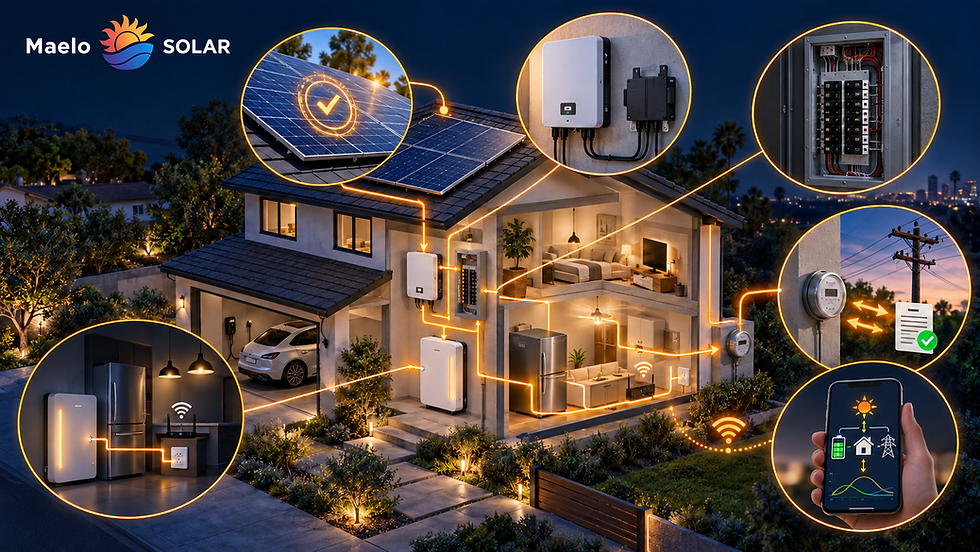
Define the Outcome Before Defining the Equipment
A conventional grid-connected solar system produces electricity when sunlight is available. Without battery storage, solar energy generally cannot be stored for later use inside the home. Standard grid-tied solar systems also generally shut down during a utility outage as a safety measure.
A battery gives the home another energy source and another layer of control.
These are system-design questions, not product-selection questions.
6 Things to Establish Before Adding a Battery
A responsible retrofit assessment should establish six things before equipment is selected.
1. Existing Solar System Health
A battery stores energy. It does not repair an underperforming solar array, failed inverter, or damaged wiring. If the existing system has a problem, adding storage before understanding that problem can complicate the project rather than solve it.
Maelo Rule: Preserve what works. Correct what does not.
2. Existing Inverter Architecture
Not every solar system is built the same way (String inverters vs. Microinverters vs. Older proprietary equipment). Equipment ratings, solar-system size, coupling configuration and the proposed battery architecture all affect what can be designed and installed.
3. Electrical Infrastructure
The battery must become part of the home's electrical system. The assessment may need to consider the main electrical panel, available breaker capacity, existing loads, conduit requirements, and proposed battery location.
The same battery can represent very different projects in two different homes.
4. Backup Objective (Essential vs. Whole-Home)
"Backup power" is not one specification. An essential-load design might prioritize the refrigerator, internet, and lighting. A whole-home architecture may be designed around substantially larger simultaneous loads (like A/C or an EV charger).
The question isn't "How large is the house?" It's "Which loads need to operate at the same time?"
5. Utility and Interconnection Status
For California homeowners, this is critical if the existing solar system operates under a legacy tariff such as NEM 2.0. Homeowners should not assume that adding equipment is administratively neutral.
6. Monitoring and Long-Term Serviceability
The goal is not simply to have an app. The goal is to have trustworthy system data representing Solar → Home → Battery → Grid. Correct metering, commissioning and configuration matter.
Power vs. Capacity: The Critical Difference
Battery discussions often reduce the decision to one number. That can be misleading.
Tesla lists Powerwall 3 with a nominal energy capacity of 13.5 kWh and up to 11.5 kW of continuous AC power per unit. Those specifications matter, but they do not determine backup duration by themselves.
Battery runtime depends on how much energy is available and how quickly the home consumes it.
Storm Watch Is Useful. Good Design Comes First.
Tesla's Storm Watch feature is designed to charge Powerwall when a qualifying severe-weather event is forecast. During an outage, a properly configured system can isolate the home from the grid and use stored energy while supporting eligible solar operation.
That automation can be valuable. But automation does not replace system design. Storm preparation is a feature. Backup performance is a system-design outcome.
Why Existing Solar Changes the Battery Decision
Adding storage to an existing solar system is different from designing solar + battery for a new home. The homeowner already owns infrastructure that has a history, a production profile, an inverter architecture, and potential tariff implications.
Do not begin with the battery. Begin with the home, the existing solar system and the outcome the homeowner expects.
Frequently Asked Questions
Already Have Solar? Find Out What Your System Can Do Next.Maelo Solar Repairs & Retrofits evaluates existing solar, electrical infrastructure, backup priorities, monitoring and battery compatibility—even when another company installed the original system. ✓ CA Licensed Contractor #1148834 | Serving the San Francisco Bay Area. |


Comments