
Safe Harbor Solar Funds, Institutional Ownership, and What Homeowners Should Know in 2026

San Francisco Bay Area Homeowner Guide
A Common Question We Hear in 2026
"If the federal solar tax credit is gone, how are solar subscriptions still possible?"
It's a fair question. The short explanation is this: The tax credit didn't disappear entirely. It changed who can access it.
To understand why, you need to know the difference between residential ownership and institutional solar ownership—and how Safe Harbor rules work.
What Is a Safe Harbor Solar Fund?
A Safe Harbor Solar Fund is an institutional investment vehicle used to develop solar projects over time. Its defining feature is this:
These funds don't exist to sell solar to homeowners directly. They exist to own and operate solar assets at scale, under long-standing IRS rules.
Why Homeowners Lost the Credit - and Institutions Didn't
The confusion comes from two completely different sections of the tax code.
RESIDENTIAL SOLAR
Governed by Section 25D.
Required install by 12/31/2025.
No Safe Harbor provisions.
Result: If not live by date, credit is GONE.
INSTITUTIONAL / COMMERCIAL
Governed by Section 48 / 48E
Uses "Beginning of Construction" rule
Allows qualification before completion
Result: Institutions only had to BEGIN.
How Safe Harbor Actually Works (Without the Jargon)
To legally establish that a project "began construction," institutions use IRS-approved methods:
Method 1: Physical Work Test. Proving meaningful work (foundations, racking) began before the deadline.
Method 2: Equipment Procurement. Purchasing critical equipment before cutoff dates to "grandfather" projects in.
The Continuity Rule: Projects that began construction in 2025 are given up to four years to be completed. This means a project going live in 2027 or 2028 can still carry the 2025 tax credit economics.
What This Means for Homeowners
Homeowners can no longer claim the credit directly. But because institutional owners can, that benefit doesn't disappear. It shows up indirectly as:
Lower effective energy pricing
$0-down system structures
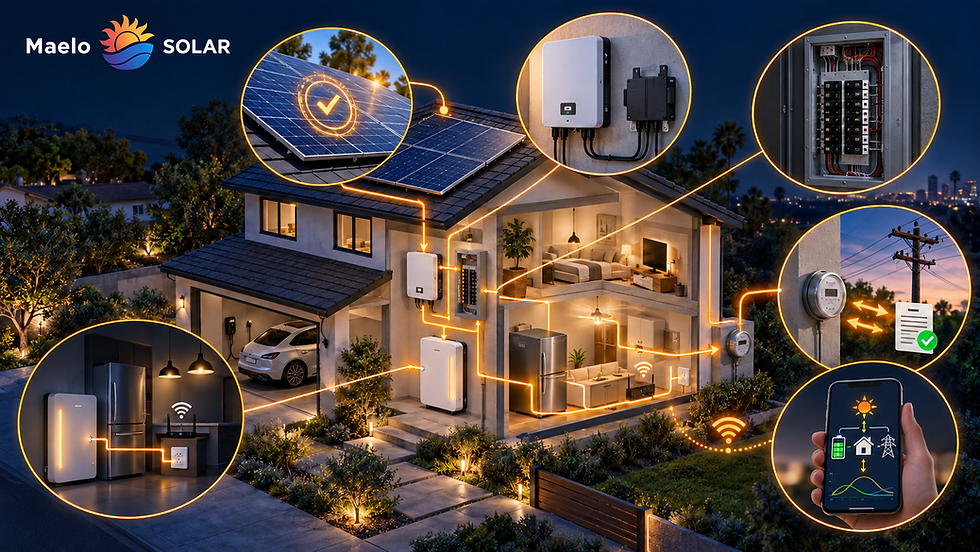
Integrated battery storage included
This is why solar subscriptions replaced ownership in California. Not because homeowners "lost something," but because capital and risk moved upstream.
Where Maelo Solar Fits
Maelo Solar is not a fund. We don't sell tax products. Our role is to sit between the homeowner and institutional platforms. We:
Evaluate roofs, usage, and PG&E rate exposure.
Right-size solar and battery storage.
Translate institutional underwriting into plain English.
Why this matters in PG&E territory: PG&E customers face some of the highest rates in the country ($0.48+/kWh). The value of solar in 2026 isn't about eliminating the bill—it's about structurally replacing the most expensive portion of it with a pricing model designed to hold over time.


Comments